Samstag, 28. August 2010

Jugendzimmer - 1973 Modella - Teenager's room


In den 60ern und 70ern entstand ein neuer Zimmertyp: 
das Jugendzimmer
 - hier auch aufs Puppenhaus übertragen. 
Dieses Jugendzimmer ist unter dem Dach. 
Balken, Wände und Boden sind aus bedruckter Pappe, 
dazu Möbel und Zubehör aus Plastik.


Das Mädchen muss reiche Eltern haben, 
wer hatte denn zu dieser Zeit ein Fernsehen, Radio, 
Plattenspieler und ein Telefon im Zimmer?
Wer hatte überhaupt ein Zimmer für sich allein?
 Puppenstuben haben immer einen Trend repräsentiert 
- und welches Mädchen hätte nicht von so einem Zimmer geträumt? 
Warum sollte man ihr nicht wenigstens die Miniaturausgabe schenken.


 Der Raum ist nicht im Originalzustand.
 Der Sessel ist von mir ergänzt, 
es gehört eigentlich ein Plastik-Drehstuhl in blau dort hin, 
 ursprünglich hangen am Dachbalken zwei Gitarren
 und auf dem Boden müssten noch zwei Tennisschläger liegen. 


Der Teenager ist aus den 80ern, denke ich, 
das Erna-Meyer-Mädchen sieht in ihrer chicen Lederhose 
und ihrer herausfordernden Haltung 
aber wie die Bewohnerin dieses kleinen Paradieses aus.


A new market: furniture designed especially for young people,
 here adopted for the dolls house.
 This room is under the roof.
 Beams and walls are made of cardboard, 
with plastic furniture and many accessoires. 
The girl has wealthy parents, who else had a TV,
 a radio, a record player and a telephone in her room?
 Who had a room of her own anyway? 
But dolls houses always represent the trend of a time -
 and every girl would have dreamed of such a room - 
so why not give her the miniature edition at least? 

The room is not complete: it is not the original armchair
 and a second guitar and the tennis rackets are missing.
 The Erna-Meyer-doll is from the 80s, I guess,
 she is wearing fashionable leather trousers.


Ich bat einen Freund wegen der Poster um Hilfe, 
da ich mir nicht so sicher war, 
wen sie darstellen: Jimi Hendrix, klar, stand ja drauf,
 Che Guevara, Dieter Thomas Heck, 
bei den anderen konnten wir uns nicht einigen, wer soll die Frau sein? 
Juliane Werding? "Am Tag, als Connie Kramer starb"? 
Der blinde Sänger könnte Ray Charles sein,
 aber ich denke zu dieser Zeit eher Stevie Wonder. 
Links der Sänger spielt eine Sitar, laut Auskunft meines Freundes, 
ist es aber keiner der damals bekannten Sitar-Spieler 
(ich wusste gar nicht, dass es Sitar-Spieler gab).

02.08.2017
OKKO BEKKER Sitar & Electronics
Danke, Georgia!

I asked a friend, who is a great music fan,
 about the posters on the wall because I was not sure about every one of it:
 Jimi Hendrix, Che Guevara, 
Dieter Thomas Heck (wellknown german discjockey of this time),
 Stevie Wonder (or Ray Charles?) but who is playing the sitar?


1974
also nur ein Jahr später, gab es eine Modelländerung bei Modella.
Das Farbkonzept für das Teenagerzimmer wurde beibehalten,
das Möbeldesign aller Zimmer wurde in ein modulares System umgewandelt.
 Just one year later, Modella underwent a model change.
The colour concept for the teenager's room was retained,
and the furniture design for all rooms was converted into a modular system.


Modella-Jugendzimmer im VEDES-Katalog
unten links


 Zuletzt aktualisiert 1.9.2025
 
  Wenn nicht anders vermerkt, sind alle Fotos aus meiner Sammlung
diePuppenstubensammlerin
Dieses Werk ist lizenziert unter einer Creative Commons Namensnennung - Nicht kommerziell - Keine Bearbeitungen 4.0 International Lizenz. 

Donnerstag, 26. August 2010

The history of Moritz Gottschalk's doll houses - English version


In 1865 Moritz Gottschalk - born 1840 - founded a bookbinding shop
 in the small town Marienberg in the Ore Mountains of Germany. 
From 1873 on he produced dollshouses and other toys. 
When two years later the railway came
 to Marienberg the factory grew larger and larger. 
They exported to England, France, the Netherlands, Scandinavia and America. 
That is why Gottschalk doll houses can be found all over the world.
 In some capitals were showrooms of his products
 and in the USA was an agency of his firm. 
His doll houses were world famous.

The architectural styles of each period were transfered to the miniature houses. 
The wooden dollhouses were often pasted with lithographic paper, 
which imitated the facades of the time. 
Windows at the sides of the building were sometimes only drawn on the paper.

Until about 1919 the roofs were blue after that they were red. 
Many doll houses were marked underneath 
with a number which can be found in the catalogues.

The designers' inventiveness was unlimited:
abundantly decorated, huge and luxurious dolls mansions,
 but also the small cottage, houses with a dolls' lift, 
with extricable or hinged gardens, with electric light,
 with moveable awnings, even round room boxes or dollhouses, caravans, kitchens,
 foldable room boxes, school rooms, baths, stables, later garages, castles,
 shops of any kind, from the butcher's to the apothecary's, 
from the magnificent pastry shop with café to a grand department store,
 or a market hall, a farm, a house boat, an airport, a theatre or a garden with pavillons.

 
1930 Furniture by Moritz Gottschalk


Christian Hacker and Albin Schönherr were further 
world-famous dollhouse manufacturers of that period. 
Schönherr was a former employee of Moritz Gottschalk 
and many of his dollhouses are barely distinguishable from Gottschalk's houses.
 What is more, naturally other companies copied the style of the period,
 too, thus complicating the identification even more.
1905 Moritz Gottschalk died but the company remained family-owned, 
first by his son, who died in WWI, then by his widow.

1933


 Since 1931 a former employee,  Kurt Alfred Wagner, owned the firm.
 He retired in 1934 and his son was the next to lead the business. 
He married a granddaughter of the founder Moritz Gottschalk, Lotte Haunstein.
During the world wars the production stopped. 


After WWI it took some time before a new catalogue was published,
 and the first catalogues assumed the pre-war style. 
But after 1923 there were only newly designed models to be found in the catalogues.


 1952
 
After WWII this toy manufacture, too, was in the eastern zone of occupied Germany 
and the Soviets disassembled large parts of still existing factories 
to ship them to the Soviet Union as a form of reparations.


Nevertheless from 1947 on the Moritz Gottschalk company built dollhouses again. 
The end of the long-established firm came 1972 
when all remaining private enterprises of the 
German Democratic Republic were dispossessed and nationalized.
 Toy companies were incorporated in the nationally-owned enterprise VERO.
 Until 1990 they continued to build single toy parts in Marienberg,
 then the fall of the iron curtain stopped the production. 
The remaining buildings were demolished in 1999 to make room for a sports hall.
 
 
The history of the once famous toy company
was almost forgotten after reunification.
Even the collector scene of antique doll's houses,
which paid small fortunes for old Gottschalk houses
(in 2000, a large house that could be played with from four sides
house was sold for DM 48,000 at Theriault),
had little information about the most famous manufacturer of their objects.
As Claus Leichsenring explained in 2013,
and as I also followed in the collectors' magazines of the time,
 the impetus for a historical reappraisal came from an American woman,
 herself an artist, but also a collector with a great thirst for research:
Evelyn Ackerman
Her book "The Genius of Moritz Gottschalk" from 1994
featured photographs and a series of catalogue pages from 1895 and 1896,
which were found in the estate of a former commercial agent.
She developed the term doll's houses with blue and red roofs.
 The beginning of a chronological classification. This is how it began.
https://issuu.com/theriaults/docs/smallcourtesies


The next treasure was found by Marianne and Jürgen Cieslik.
Probably as an effect of the reunification, 3000 photo negatives from the company,
 which produced the catalogues for Gottschalk for decades,
Paul Knäbchen in Zöblitz, were to be destroyed.
As a well-known collector/publisher couple, they were told about it.
They published a selection in 2000.
After the publication of this book, the collector scene was finally able to determine
whether their houses were really from Gottschalk and exactly how old they were.
However, not all of the catalogue pages found were actually printed.
 
There was later a reprint catalogue volume published by Swantje Köhler,
because she had found old catalogues at a flea market.
Nevertheless, the Gottschalk documentation is still not complete.

 
More photos
 
Of course you can look for photos in the archives of all toy auction houses,
as the Gottschalk objects are often recognised.
In the Vecties-Auktionshaus you can see the dark side
of toy production in Marienburg,
War toys and swastika.

The company had always produced children's war toys.
In 1933 the company name was
"Factory of fine wooden toys and children's military articles".
Advertisements in the trade journal
"Wegweiser für Spielzeug" in 1938
advertise Gottschalk's Wehrmacht articles.
After the Second World War, there were no more adverts for war toys. 

Translated with DeepL.com (free version)


Bibliography: 
 
1994 Evelyn Ackermann "The genius of Moritz Gottschalk" 
 

2000 "Moritz Gottschalk 1892 - 1931"

2003 Marianne Cieslik, Swantje Köhler "Lexikon der Puppenstuben und Puppenhäuser"

2004 Femmie Markestein, Karin Wester: "Poppenhuizen 1880-1980"


Leichsenring, Claus: Von Marienberg in alle Welt - Spielwaren von Moritz Gottschalk. In: Erzgebirgische Heimatblätter : Zeitschrift für Heimatfreunde. 2013, Heft 6, Seite 2 bis 5
 
2016 Knoll, Ulrike: Vom Kindertraum zum Sammlerobjekt : Puppenstuben, Puppenhäuser & weitere Erzeugnisse der Spielwarenfabrik Moritz Gottschalk Marienberg aus der Sammlung Knoll = From childhood dream to collector's item. Dresden: radicula Verlag. ISBN 9783000544064


Dolls' Houses Past & Present
A website and e-zine about dolls' houses: antique, vintage and modern.
Plus furniture and accessories.
Issue 22 (September 2014)
>Moritz Gottschalk - a brief history<
by diePuppenstubensammlerin
 
 The blog post has been greatly shortened by me, in March 2024,
as Google Photos had classified many of my old photos
 as not secure and therefore no longer displayed them.
However, many photos are on the website mentioned above.
In July 2024 I added information about important books. 

 
  Wenn nicht anders vermerkt, sind alle Fotos aus meiner Sammlung
diePuppenstubensammlerin
Dieses Werk ist lizenziert unter einer Creative Commons Namensnennung - Nicht kommerziell - Keine Bearbeitungen 4.0 International Lizenz.

Sonntag, 27. Juni 2010

1950er Jahre Schulzimmer - 1950s school room

aus meiner Sammlung


aus meiner Sammlung

Die Schule ist im bäuerlichen Stil.
Erna-Meyer-Biegepuppen lernen hier.

Sie sieht noch nackt aus, meine kleine Dorfschule aus den 50er Jahren,
mal sehen, was sich im Laufe der Zeit als Deko noch findet...

Work in progress.
The accessoires have still to be found for this little village school from the 50s.
I just cleaned the old wood with furniture polish.
The text cards above are from a german learning-to-read-box of that period.
They show the children sitting around tables in the schoolroom -
that means you don't even have to take desks to create a school.
 
 
************
 
Nachtrag 10.6.2023
Die Schulmöbel sind auch von Erna Meyer 1951 verkauft worden,
allerdings wurden sie nicht von ihr gefertigt.
(Quelle: Marcie & Bob Tubbs with Dian Zillner.
Dollhouse and Miniature Dolls 1840-1990. Schiffer 2009)
 

1950

 Erna Meyer bot in den Fünfziger Jahren auch ein Schulzimmer an.


 Evas Sammlung


1954


Nachtrag:
Der Hersteller der Puppenstube ist die
Spielwarenfabrik Karlheinz Klein, Wiesloch
s.a. Lexikon der Puppenstuben und Puppenhäuser

The firm who build this room box was
Spielwarenfabrik Karlheinz Klein, Wiesloch, Germany


50er Jahre Erna Meyer Puppenmode - 50s Erna Meyer dolls' fashion


Kindermode im Umbruch:
aus den Zöpfen werden Pferdeschwänze
und die Schürzen dürfen endlich weggelassen werden. 
Children's fashion is about to change at this period:
pigtails became ponytails and the aprons finally were left at home.

aus meiner Sammlung

Links ist das Mädchen mit den fortschrittlicheren Eltern,
ihre Freundin kämpft zuhause noch gegen die "alten Zöpfe".
On the left the girl with modern parents,
her friend is still struggling for the ponytail and a more fashionable dress.


Die zwei kleineren Mädchen kümmern sich noch nicht um Mode.
 Schürzen und Zöpfe, sogar die Haarschleifen sind noch da.
The two smaller girls do not mind the pigtails and the aprons.
They have still their original hair ribbons.


Der Lehrer - mit sorgfältig modelliertem Kopf und
einem ausdrucksvoll bemalten Gesicht.
The teacher, carefully painted face and 
molded head underneath the cloth.


In dem Bilderbuch "The doll family" ist diese Puppe der Vater der Familie.


Alle Fotos, die mit "aus meiner Sammlung" gekennzeichnet sind:
 Creative Commons Lizenzvertrag

Mittwoch, 16. Juni 2010

Versandhaus-Puppenstube - 1961 - Mail order roombox


 Ergänzung 24.11.2024
Die Puppenstube wurde auch vom
 Warenhauskonkurrent Neckermann
im Jahr 1962 angeboten.
Und von der westdeutschen Konsum-Genossenschaft
schon im Jahr 1961.
 
Mein erster Einrichtungsversuch mit Modella-Plastik-Möbeln von Anfang der 60er.
Links soll wohl eine Küche hin,
deshalb die angedeutete Fliesenwand,
mir fehlte aber noch ein schöner Raum für das ungewöhnliche Bett.
Das Fenster ist aufgemalt. 
My first roombox with Modella plastic furniture of about 1963.
On the left should be a kitchen,
I suppose, because of the tiled wall,
but I need a room for the unusual bed.
The window is painted on the wall.


Den Hersteller der Stube kenne ich nicht,
sie wurde in diesem Karton von Quelle verschickt.
The box of the big mail order firm Quelle
in which the doll roombox was sent to the customer.


Quelle Katalog 1963


Hier ist eine Katalogabbildung.
Rechts werden ähnliche Modella-Möbel im Set angeboten.

 Früher sortierte ich Plastikmöbel gleich aus und
kaufte möglichst nur die "wertvolleren" Holzmöbel,
aber seit einiger Zeit bin ich dem Design von gut gefertigten Kunststoffmöbeln verfallen.
Die Tagesdecke des Bettes und die Verkleidung des Frisiertischs
waren ursprünglich in einem flattrigen dünnen rosa-gepunkteten Stoff,
auf dem letzten Foto zu sehen, mal sehen, ob ich einen ähnlichen Stoff finde.
 There was a time when I discarded all plastic furniture from my collection
and I only kept the "valuable" wooden items
but that attitude has changed very much.
The bed cover and the dressing table's curtain were of a thin pink dotted cloth,
to be seen on the last picture,  I hope I will find something similar.


Das aufgemalte Fenster.
The painted window.


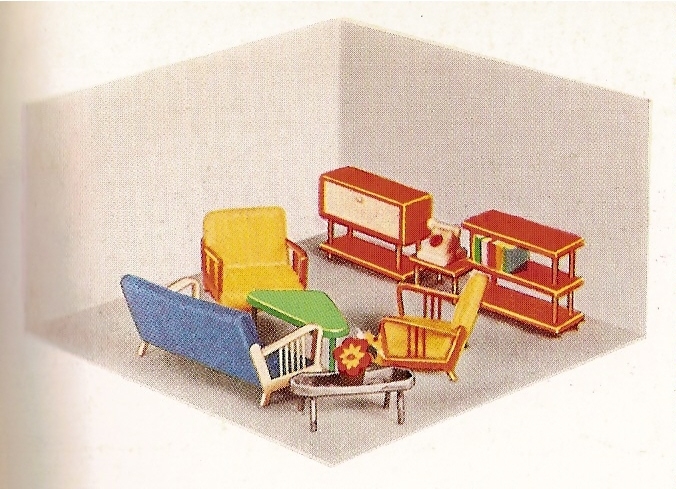
Das Wohnzimmer ist ebenfalls nur mit Modella-Möbeln aus dieser Zeit eingerichtet.
Die Bilder zeigen die typischen Märchenmotive.
Furniture of Modella only.
Pictures showing scenes of fairytales.


"Das Spielzeug" 1959
Ad of 1959

Die alten Modella-Möbel wurden entweder kaum aufgehoben
 oder gingen schnell kaputt, 
sie sind seltener zu finden als Holzmöbel aus dieser Zeit.
The old plastic furniture of Modella survived only very rarely,
either it was not kept on purpose ("just plastic") or it broke quickly.
It is more difficult to find than wooden furntiture of the same period.


"Das Spielzeug" 1960


Eine Einrichtungsvariante mit Crailsheimer-Möbeln


   Wenn nicht anders vermerkt, sind alle Fotos aus meiner Sammlung
diePuppenstubensammlerin
Dieses Werk ist lizenziert unter einer Creative Commons Namensnennung - Nicht kommerziell - Keine Bearbeitungen 4.0 International Lizenz.

Dienstag, 8. Juni 2010

Häfner & Krullmann

Moderner Puppen-Bungalow Typ "Capri"


 "Spielzeug" 1962
 
Ferner lieferbar:
Typ "Florida"
mit Swimmingpool 


 Die Firma Häfner und Krullmann wurde schon 1937 in Leopoldshöhe gegründet.


"Einfacher und fester Aufbau durch 12 Schrauben"

aus meiner Sammlung

 
Die Wände und Böden des Plastik-Bungalows muss man zusammenschrauben.
Bei meinem Exemplar fehlt u.a. das rote Flachdach
 mit der netten weißen Antenne darauf.
Das konnte man zum Spielen abnehmen.
Das einzige Haus mit Springbrunnen!
Zwar fehlt die Terrassenabgrenzung, 
dafür ist aber die schöne Blumendekoration noch perfekt. 


Typ "Florida"
mit Swimmingpool 

1963 gab es mein Modell noch etwas luxurioser mit Swimmingpool,
Vorbecken mit Dusche, Sonnenschirm mit Tisch,
sowie Außenleuchte mit Eckbank.
This bungalow is mostly made of plastic 
and has to be assembled from single panels.
Among other parts the roof with the wonderful antenna is missing.
My only doll house with a fountain!
The railings of the terrace are missing
 but luckily the wonderful flower decoration of the wall is not damaged at all.
In 1963 a more luxurious model was sold, with pool, shower,
parasol and table, outside lamp and corner seat. 
 
The firm Häfner & Krullmann was founded in 1937 for fabricating plastic products.


Sammlung Anna Setz


The ad for my model of the bungalow:
"Modern plastic doll bungalow which was presented at this year's Toy Fair in Nuremberg.
Can easily be assembled. 75 x 50 x 25 cm, with antenna 40 cm high.
The roof can be removed, one front is completely made of transparent plastic,
furthermore there is a terrace with a fountain.
Through the glass front the plastic furniture in the house can be seen."


aus meiner Sammlung

Von oben sieht man die Zimmerverteilung und die Linoleumböden.
From above the linoleum floors can be seen. 
 

aus meiner Sammlung

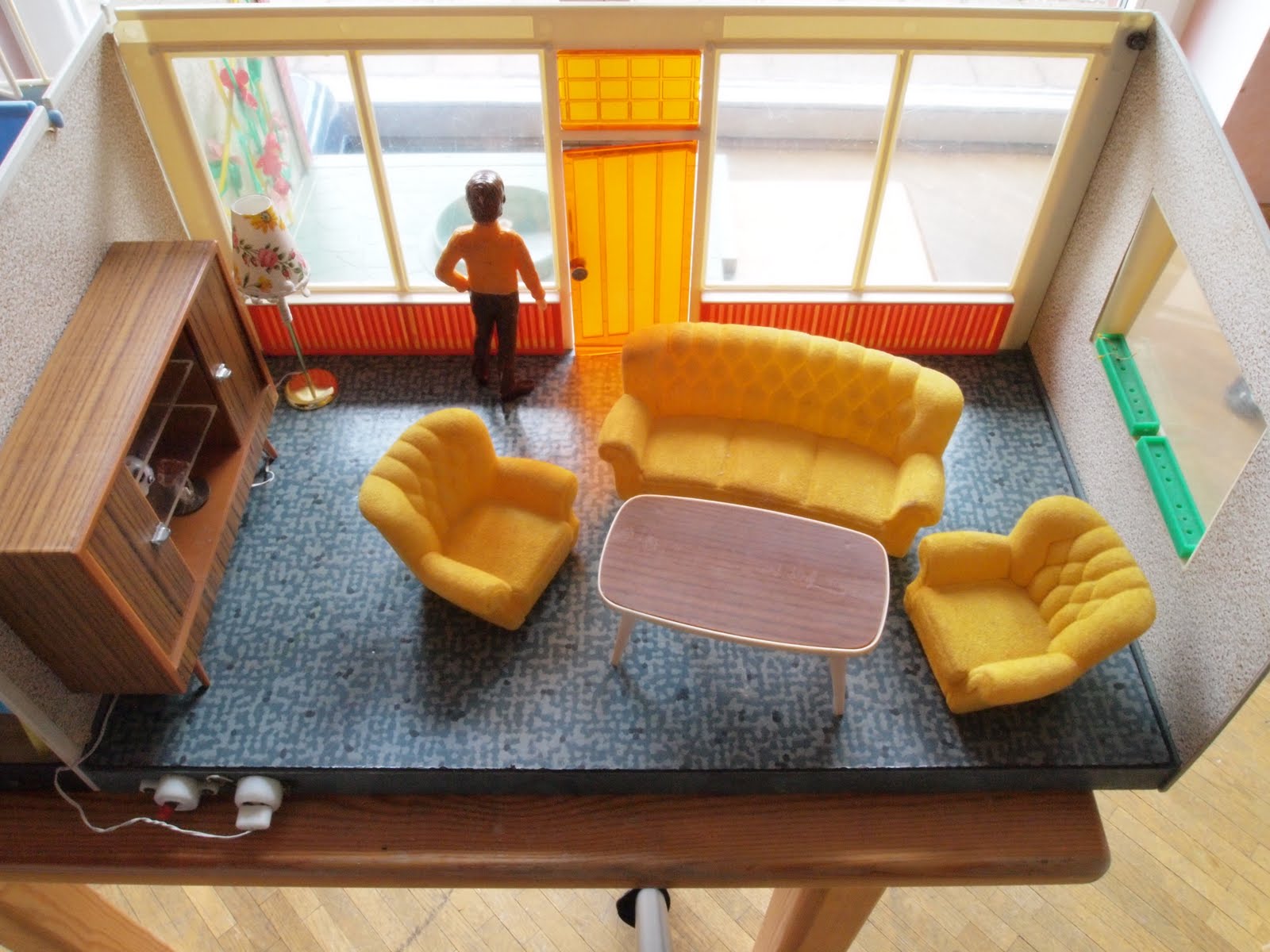
Die orange Haustür taucht das Wohnzimmer in ein interessantes Licht.
Die scheußliche Postergarnitur lief sicher unter der Bezeichnung "Stilmöbel",
aber es gibt ganz bestimmt Möbel mit mehr Stil...
Sie wurden auch von Crailsheimer gefertigt.
Muss ich eigentlich ein häßliches Teil in meine Sammlung aufnehmen,
nur weil es auch in diese Zeit gehört? Nein, das muss nur ein Museum.

The living room is bathed in a warm orange light by the coloured entrance door.
Not the most stylish livingroom because of the hideous plastic sofa and armchairs,
I know, but it is the original one, by Crailsheimer, too.
Does a collector sometimes have to put up with an ugly item
because it belongs to a certain period?
No, because I am not a museum after all.


 Bungalow aus Evas Sammlung


Mädchen spielt mit dem "Florida"-Bungalow


1964 "Gerda"


aus meiner Sammlung

 
Moderne Puppen-Stube: Typ "Gerda"
leicht
handlich
und doch sehr stabil

Puppenstube 4 x so groß wie dieser Karton
Einfacher und fester Aufbau durch 12 Schrauben!
Puppenstube ohne Möbel

 Komplett aus Plastik, leicht zu transportieren,
da die Einzelteile sich auseinanderschrauben lassen.

 Meine Stube ist mit Crailsheimer Plastikmöbeln aus dieser Zeit eingerichtet.
Die passenden Möbel von Häfner & Krullmann sind sehr selten.
 

aus meiner Sammlung

Modern doll apartment: Type "Gerda"
light, handy and yet very stable

Room box 4 tomes as big as this cardboard box
Easily
and sure setup with 12 screws!
Not furnished
 Complete in plastic, easy to transport,
because the individual parts can be unscrewed.
(original text on the box)

My apartment is furnished with a plastic living room by Crailsheimer.
The matching furniture by Häfner & Krullmann is very very rare.
 

aus meiner Sammlung

Das "Glasmosaikfenster" ist natürlich auch aus Plastik.
Nur die Einlegeböden der Stube sind aus biegsamen PVC-Platten.


aus meiner Sammlung


1964 "Schöner Wohnen" Heft September:
Vorbild für Lampe, Sessel, Anbauwand


aus meiner Sammlung

 Moderne Anbaumöbel


aus meiner Sammlung


aus meiner Sammlung

 Das Märchenbild gehört zur Originalausstattung der Stube.
 Aschenputtel tanzt mit dem Prinzen und die Stiefschwestern schauen neidisch zu.  
The fairy tale picture is firmly fixed and came with the room box.
Cinderella dances with the prince and her step sisters watch them grudgingly.


Die Küche mit Crailsheimer Küchenschränken.
Servierwagen, Tisch und Stühle sind von anderen Herstellern.
The kitchen with cupboards by Crailsheimer. 
The table, the chairs and the trolley are by other German firms.
 

aus meiner Sammlung


aus meiner Sammlung

 Das Caco-Mädchen trägt eine Perücke.
Caco girl of that time with a wig.


aus meiner Sammlung

Schon integrierte Wanduhr
The clock is also part of the room box.

aus meiner Sammlung

 orange Zimmertür

aus meiner Sammlung


aus meiner Sammlung

aus meiner Sammlung

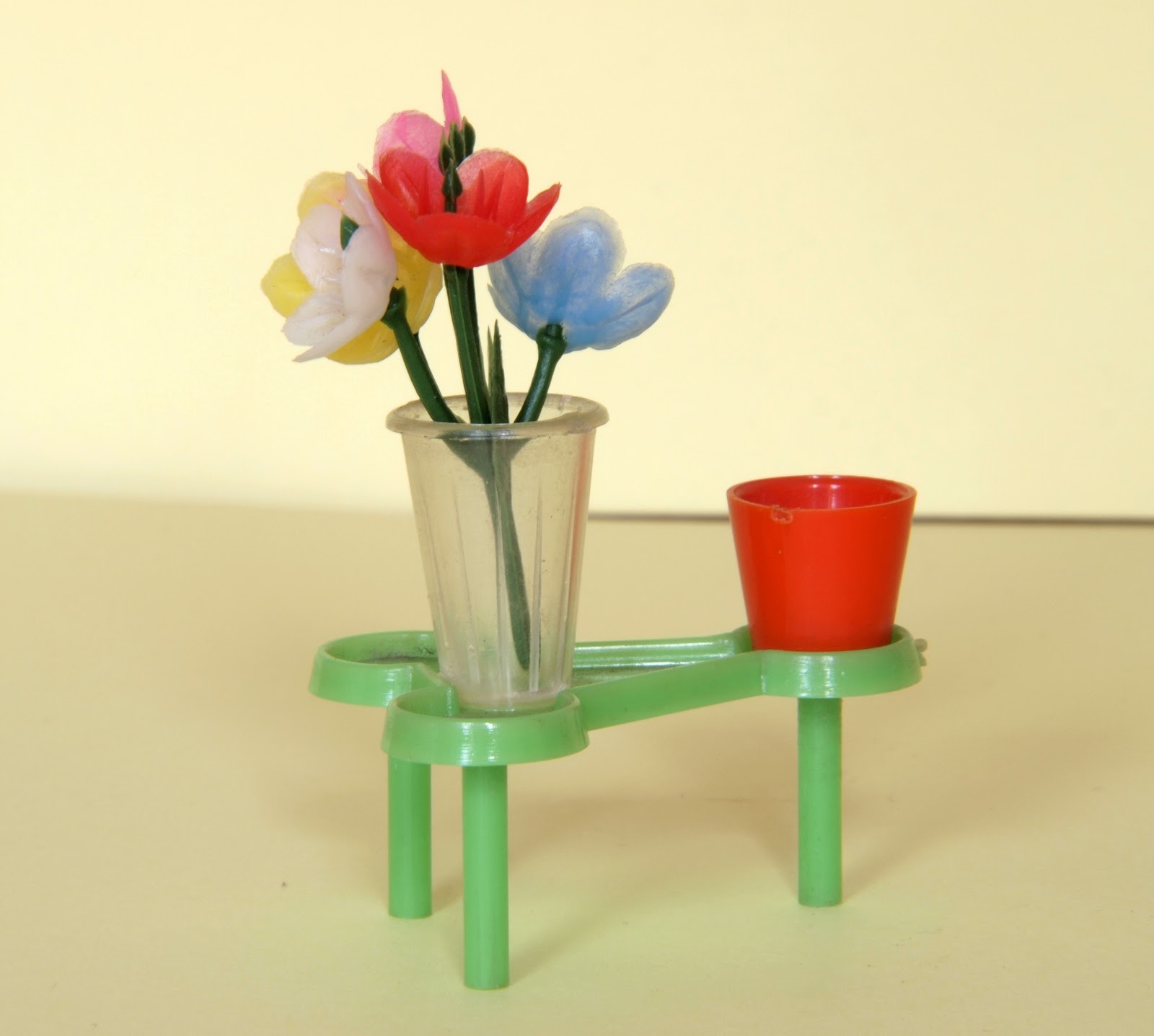
Der Blumenständer ist tatsächlich von Häfner und Krullmann.
Auf dem Karton ganz links unten.
The flower stand is by Häfner und Krullmann. You can see it on the box.


aus meiner Sammlung


1964 Quelle Katalog 
Fertighaus


A website and ezine about dolls' houses: antique, vintage and modern. Plus furniture and accessories.

Here you can read the English translation - with much more information!


aus meiner Sammlung

 
aus meiner Sammlung

 Zwei Häfner-und-Krullmann-Anbauschränke
Häfner and Krullmann living room cabinets

 
aus meiner Sammlung

aus meiner Sammlung

Sie stehen jetzt in der Küche.
As long as there are not more of them in my collection they stay in the kitchen.


aus meiner Sammlung

 Eine andere Version aus meiner Sammlung, wohl etwas später.
Another version of the room box, with different mosaic window, missing picture and different colours.

aus meiner Sammlung

Gerda


1958
 Häfner und Krullmann
stellte auch Fenster und Türen aus Plastik für das selbstgebaute Puppenhaus her,
wie man hier sieht.


Plastic windows and doors for DIY dolls houses by Häfner & Krullmann
 
 
Katalogfoto von ca. 1962


 Sie wurden auch von der Firma Elfriede Lipfert
 in ihren Puppenstuben ab Anfang der 1960er verwendet, 
als die Holzfenster durch Kunststoff ersetzt wurden. 
Genauso wie von Kibri und der Firma Homü.


-Updated 2025


Alle Fotos, die mit "aus meiner Sammlung" gekennzeichnet sind:
 Creative Commons Lizenzvertrag